
The Republic of Vanuatu is a commonwealth country, located in the Pacific Ring of Fire is an archipelago of 83 islands in the South Pacific Ocean, east of Australia. Known for its pristine beaches, active volcanoes like Mount Yasur, and rich Melanesian culture, the country gained independence in 1980 from joint British and French rule. The capital is Port Vila.
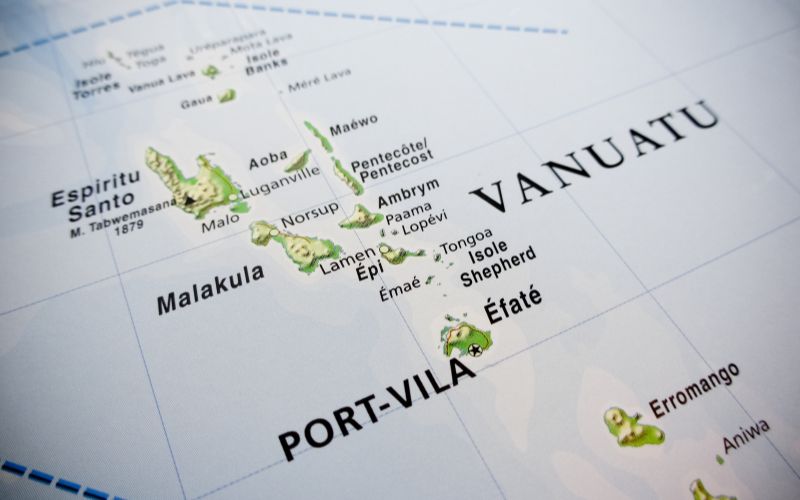
The Republic of Vanuatu is an island nation located in the South Pacific Ocean. The archipelago is located some 1,750 km east of Australia, 500 km north-east of New Caledonia, west of Fiji and south of the Solomon Islands. It was named New Hebrides during its colonial period. Vanuatu is only 2.5 hours flying time North East of Brisbane and 3.5 hours from Sydney, Australia. It’s a little over 2 hours from Auckland, New Zealand. There are regular flights from New Zealand, Honiara, Australia, Noumea and Fiji.
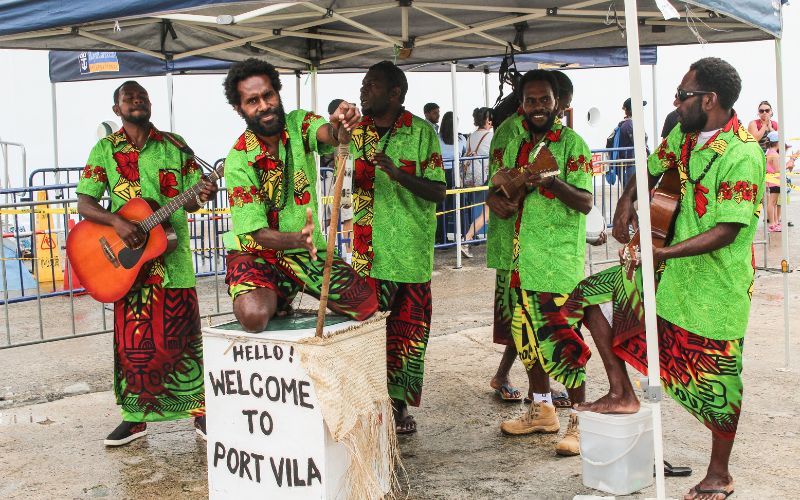
Vanuatu’s name derives from the word vanua (‘land’ or ‘home’). Vanuatu boasts incredible cultural diversity, making it one of the most linguistically diverse countries in the world with over 100 indigenous languages spoken Bislama, English, and French are the official languages.
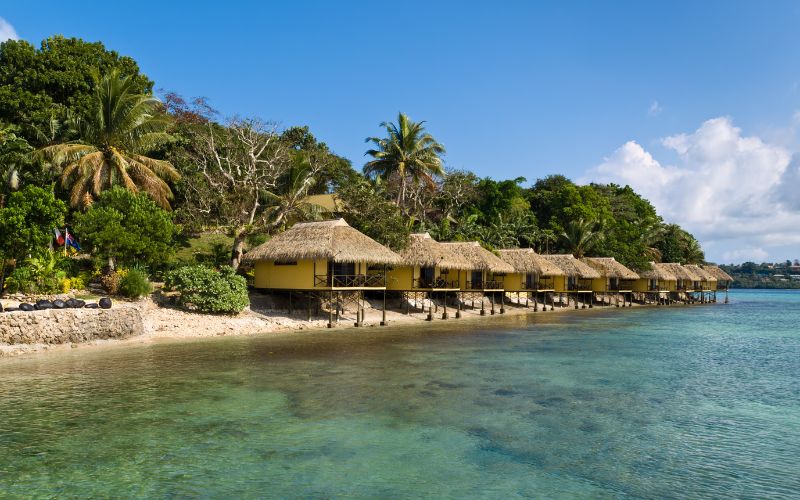
Vanuatu’s economy relies heavily on subsistence agriculture, the islands are a major international tourist destination
History
Many of the islands of Vanuatu have been inhabited for thousands of years, the oldest archaeological evidence found dating to 2000 BC. In 1605, the Portuguese explorer Pedro Fernández de Quirós became the first European to reach the islands, believing it to be part of Terra Australis. Europeans began settling the islands in the late 18th century, after British explorer James Cook visited the islands on his second voyage, and gave them the name New Hebrides. In 1887, the islands began to be administered by a French-British naval commission. In 1906, the French and British agreed to an Anglo-French Condominium on the New Hebrides. During World War II, the islands of Efate and Espiritu Santo were used as allied military bases. In the 1960s, the ni-Vanuatu people started to press for self-governance and later independence; full sovereignty was finally granted by both European nations on July 30, 1980. It joined the UN in 1981, and the Non-Aligned Movement in 1983.
Politics
The parliament of Vanuatu is unicameral, and has 52 members; these are elected every four years by popular vote. The leader of the main party in the parliament is usually elected Prime Minister, and heads the government. The head of state, the President, is chosen every five years by the parliament and the presidents of the six provincial governments.
Provinces
Since 1994, Vanuatu has been divided into the six provinces of Malampa, Penama, Sanma, Shefa, Tafea and Torba. The main Islands within these provinces include: Banks and Torres (Torba), Espiritu Santo (Sanma), Maewo and Pentecost (Penama), Malekula, Ambrym (Malampa), Epi, Efate (Shefa), Erromango, Tanna and Aneityum (Tafea)
Geography
Vanuatu is an archipelago of 83 islands, of which two — Matthew and Hunter — are also claimed by the French overseas department of New Caledonia. Of all the 83 islands, 14 have surface areas of more than 100 square kilometers, from largest to smallest: Espiritu Santo (3956 km), Malakula (2041 km), Éfaté (900 km), Erromango (888 km), Ambrym (678 km), Tanna (555 km), Pentecôte (491 km), Épi (445 km), Ambae or Aoba (402 km), Vanua Lava (334 km), Santa Maria (328 km), Maéwo (304 km), Malo (180 km) and Anatom or Aneityum (159 km). Most of the islands are mountainous and of volcanic origin, and have a tropical or sub-tropical climate. The nation’s largest towns are the capital Port Vila, which is situated on Efate, and Luganville, on Espiritu Santo. The highest point in Vanuatu is Mount Tabwemasana, at 1879 m (6158 ft), on the island of Espiritu Santo. There are several active volcanoes in Vanuatu, including Yasur on the island of Tanna, one of the world’s most accesible volcanoes, as well as several underwater ones.
Ecology
Vanuatu is recognized as a distinct terrestrial ecoregion, known as the Vanuatu rain forests. Vanuatu is part of the Australasia ecozone, which also includes neighboring New Caledonia and the Solomon Islands, as well as Australia, New Guinea, and New Zealand.
Economy
The economy is based primarily on subsistence or small-scale agriculture, which provides a living for 65% of the population. Fishing, offshore financial services, and tourism (with about 60,000 visitors in 2005), are other mainstays of the economy. Mineral deposits are negligible; the country has no known petroleum deposits. A small light industry sector caters to the local market. Tax revenues come mainly from import duties and a 12.5 percent Value Added Tax (VAT) on goods and services.
Demographics
Vanuatu had a population of 224,564 (July 2011 estimate). Most of the population is rural, though Port Vila and Luganville have populations in the tens of thousands. Most of the inhabitants of Vanuatu (98.5%) are native Melanesian, or Ni-Vanuatu, with the remainder made up of a mix of Europeans, Asians and other Pacific islanders. A few of the islands are Polynesian outliers. About 2,000 Ni-Vanuatu live and work on New Caledonia.
| Category | Details |
|---|---|
| Official Name | Republic of Vanuatu |
| Native Names | Ripablik blong Vanuatu (Bislama); République de Vanuatu (French) |
| Motto | Long God yumi stanap (Bislama); Nous nous tenons devant Dieu (French); “With God We Stand” |
| National Anthem | Yumi, Yumi, Yumi (“We, We, We”) |
| Capital | Port Vila |
| Largest City | Port Vila |
| Official Languages | Bislama, English, French |
| Ethnic Groups (2020) | 98.5% Ni-Vanuatu; 1.5% Others |
| Religion (2020) | 93.4% Christianity (75.1% Protestant, 13.5% Catholic, 4.8% Other Christian); 4.6% Animism; 1.4% Baháʼí Faith; 0.6% Other/None |
| Demonym | Ni-Vanuatu (rarely: Vanuatuan) |
| Government | Unitary parliamentary republic |
| President | Nikenike Vurobaravu |
| Prime Minister | Jotham Napat |
| Legislature | Parliament |
| Independence | 30 July 1980 (from the United Kingdom and France) |
| Total Area | 12,189 km² (4,706 sq mi) |
| Population (2023 est.) | 335,908 |
| Population (2020 Census) | 300,019 |
| Population Density | 27.6 people/km² (71.5 people/sq mi) |
| GDP (PPP, 2023) | US$1.002 billion |
| GDP (PPP) Per Capita | US$3,001 |
| GDP (Nominal, 2023) | US$1.064 billion |
| GDP (Nominal) Per Capita | US$3,188 |
| Gini Index (2019) | 32.3 (Medium inequality) |
| Human Development Index (2023) | 0.621 (Medium) |
| Currency | Vatu (VUV) |
| Time Zone | UTC+11 (Vanuatu Time – VUT) |
| Calling Code | +678 |
| ISO 3166 Code | VU |
| Internet TLD | .vu |